
Breaking News! visionICs VR9150: Focusing on the Core of Sensing Adaptation, Forging a New Foundation for the Intelligent Sensing Industry
In the field of intelligent sensing, the core of innovation lies in building high-performance chips—and our key pursuit is to enable these chips to precisely adapt to intelligent devices such as automotive, robotics and UAVs, making them the exclusive core sensing support for such equipment. At visionICs, we have always risen to challenges and been committed to breaking the technological boundaries of chips. We have never stopped exploring, whether it is breaking through the technical barriers of single-photon level detection or pioneering new paths for the seamless integration of physical sensing and AI decision-making.
However, in the process of promoting multi-scenario implementation, we have gradually identified a critical bottleneck: existing 3D sensing chips are either constrained by the low-light performance shortcomings of consumer-grade products or limited by the volume and cost pressures of industrial-grade equipment, and have thus far failed to accurately meet the personalized demands of different scenarios.
Hence, VR9150—the core chip developed by visionICs after in-depth research into multi-scenario sensing needs and tailor-made for diverse scenarios—was born.
Challenge: Creating a Pair of "Myopia-Free, Low-Latency" Eyes for Intelligent Devices
The original aspiration behind developing the VR9150 is not to "build a more powerful chip", but to solve the fundamental problems of intelligent sensing—empowering AI to "see clearly, respond quickly and adapt widely" in all environments. Technological indicator breakthroughs mean an extra layer of safety assurance. This requires facing up to three major industry-level challenges:
- The Trade-off Between Low-Light Performance and Speed: Traditional photoelectric sensors have low photosensitivity efficiency; the VR9150 achieves a single-photon photosensitivity efficiency of 29% with a response time of less than 10ns.
- Balancing Adaptability and Performance: Scenarios such as autonomous driving wide-angle perception, robot obstacle avoidance and UAV long-distance detection have vastly different requirements. General-purpose chips either have single functions or require additional modules that increase volume and cost.
- The Contradiction Between Precision and Commercialization: Automotive applications demand centimeter-level ranging precision, which conflicts with system laser energy and quantization errors.
Core Advantages of VR9150: Empowering AI to "See Intelligently, Adapt Flexibly, and Commercialize Seamlessly"
If AI is the "brain" of intelligent devices, the VR9150 is the "eyes that understand the brain best". It has completely revolutionized the intelligent sensing experience with three core advantages:
1. Ultra-HD Sensing: Enabling AI to "See Fine Details and Never Miss Risks"
- 29% Ultra-High PDE: Captures "photon-level" weak signals even in low-light scenarios such as moonlight and tunnel entrances/exits, solving the pain point of traditional chips that "see clearly in the day but blurrily at night".
- <10ns Ultra-Fast Response: Faster data acquisition than industry standards ensures AI receives "real-time and fresh" spatial information, avoiding decision-making errors caused by latency.
- >25K Pixels + 150° Wide Angle: The 4:3 golden aspect ratio balances "details and panoramic view", enabling AI to clearly recognize a pedestrian's gestures 100 meters away and cover blind spots on both sides of a vehicle, achieving "360° risk-free" AI decision-making.
2. Multi-Scenario Adaptability: Enabling AI to "Span All Industries Without Changing Its 'Eyes'"
The VR9150 is like a "versatile sensing expert" that flexibly switches modes for different scenarios:
- Supports multiple operating modes including 1D/2D/line scan.
- Enables in-frame ROI and variable integration times.
- Offers Range, Echo and Histogram data output modes.
3. High Integration + High Precision: Enabling AI to "Commercialize Effortlessly Without Cost Escalation"
- High Precision: Built-in special calibration circuit delivers a ranging precision of ±2cm, meeting the requirements of autonomous driving safe distance judgment and smart lawnmower high-precision mapping.
- High Integration: Integrated DSP engine can directly calculate and output point cloud information without relying on external FPGA/SOC computing power, greatly reducing the load and cost of customers' main control equipment.
- Easy Adaptation: Supports the standard MIPI protocol, allowing flexible adjustment of frame data volume and image aspect ratio parameters. It seamlessly connects with various computing platforms such as FPGAs and SOC domain controllers, shortening the development cycle.
Scenario Implementation: From "Obstacle Avoidance" to "Prediction", VR9150 Restructures the Intelligent Experience
The value of technology ultimately lies in scenario implementation. Today, with its ultra-strong "sensing capability", the VR9150 is turning more intelligent scenarios from "concepts" into "reality":
1. Equipping Vehicles with a "Predictive Safety Shield"
The VR9150 provides core support for autonomous driving blind-spot detection: its 150° wide-angle coverage breaks the field-of-view limitations of traditional sensors, capturing the surrounding environment of vehicles without dead angles. It accurately identifies pedestrians jaywalking, bicycles parked on the roadside and sudden obstacles, and is highly adaptable to all lighting conditions such as strong light, backlight and dim twilight, maintaining stable sensing at all times. It enables autonomous driving to completely eliminate visual blind spots and environmental interference, further expanding the safety boundary.
2. Empowering Robots to "Respond to Complex Environments Independently"
In robotic applications, the VR9150 enables high-precision environmental modeling, real-time obstacle avoidance and path planning. It not only ensures continuous low-power operation but also enhances obstacle avoidance performance and operational stability.
3. Enabling UAVs to "Navigate Freely in All Weather Conditions"
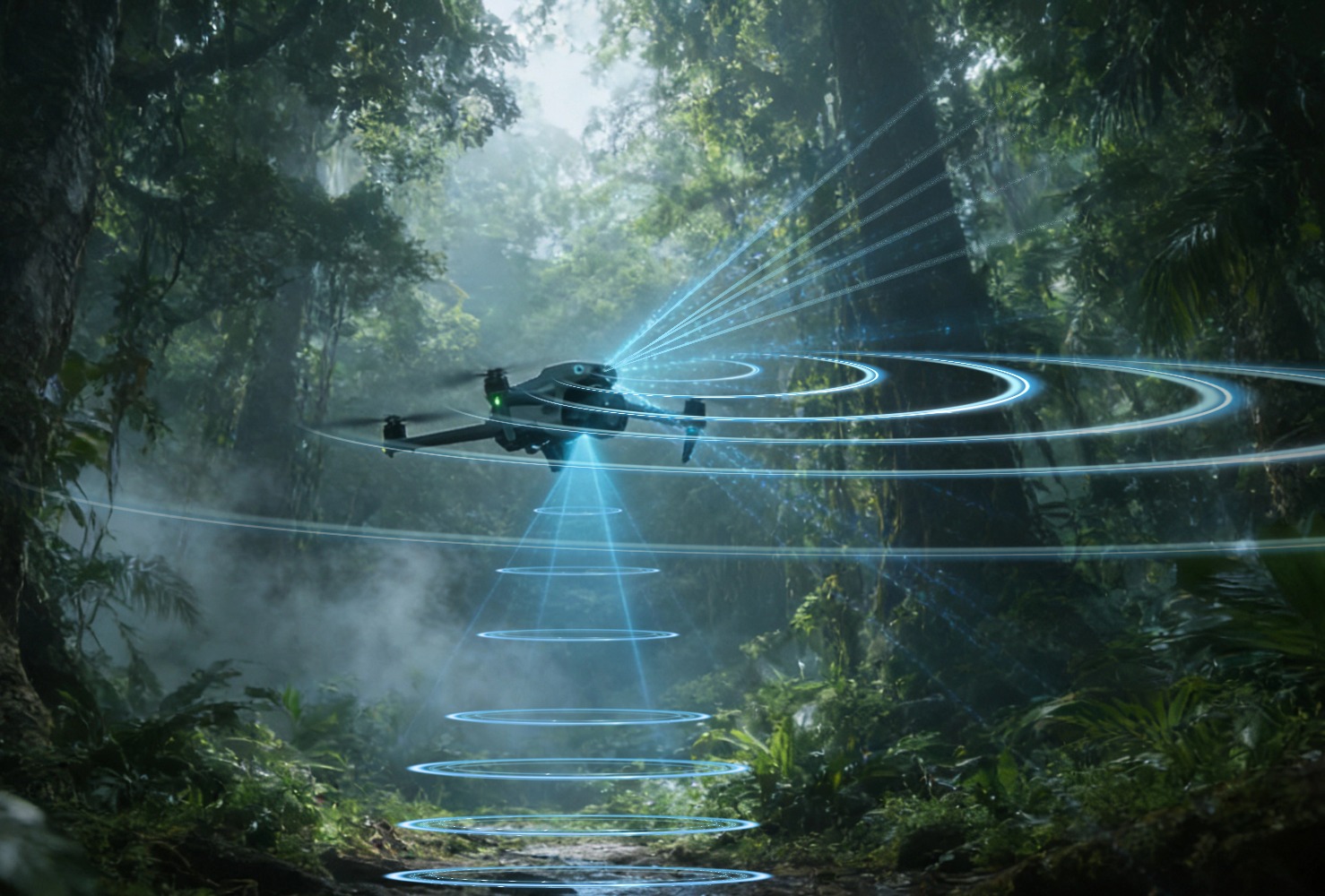
In UAV obstacle avoidance scenarios, the VR9150 demonstrates hardcore performance: its ultra-high ranging precision accurately locks the position of obstacles; its long detection distance allows early perception of distant obstacles to reserve response time; it captures signals stably regardless of complex lighting such as strong and low light; and it can acutely detect small objects such as branches and plastic bags, building a multi-dimensional obstacle avoidance defense line for UAVs to navigate safely in all environments.
4. Ensuring Smart Lawnmowers "Never Cross Boundaries or Miss Mowing Areas"
Smart lawnmowers often either mistakenly mow flowers and plants in flower beds or miss weeds in corner areas due to "inaccurate boundary recognition". The VR9150's boundary recognition and high-efficiency mapping algorithm enable lawnmowers to accurately lock in the "operation area" and maintain long-term stable work.
Someone asks: What is the core goal of the VR9150? Our answer is: to become a leader in optical sensors by making "sensing more precise and decision-making more reliable".
visionICs' product philosophy goes beyond building high-performance chips; we are committed to optimizing the practical path of intelligent sensing through chip technology. Just as the leap from feature phones to smartphones is not about parameter accumulation but about "experience upgrading", the VR9150 is poised to provide core support for the experience upgrading of intelligent sensing.
The exploration of the VR9150 is visionICs' response to the intelligent era. This is just the beginning—there will be more innovative breakthroughs in sensing technology in the future. We look forward to working hand in hand with peers to make the "interconnection of all intelligent things" safer and better through more precise sensing.